What Is Used to Configure Data Sources for Applications That Require Access to a Database?
Access provides a feature-rich platform for developing database applications. A database application is a computer program that provides both a mode to store and manage information and a user interface that follows the logic of business tasks (application logic). This article discusses basic deployment planning, packaging and signing, deploying database applications, and the Access Runtime environment.
What do you want to practice?
-
Plan for deployment
-
Deploy an Access application
-
Understand and download the Access Runtime
-
Create an installation package
-
ACE no longer requires a split up installation to interact with not-Part apps
Programme for deployment
Before you begin, you should enquire yourself the post-obit questions about the way that the application will be deployed.
Should the data and the logic exist separated?
You tin can create an Access application that combines information management and application logic in i file. This is the default application structure in Access. Combining data management and application logic in ane file provides the simplest deployment method, merely this method works best only if a few people use the awarding at the aforementioned time, and it involves some risk. For example, a user could cause data loss by unintentionally deleting or damaging the application file. In most cases, yous should split data management and application logic. This helps improve operation and reliability.
I mode to separate data and logic is by using the Access Database control (on the Database Tools tab, in the Move Data grouping). This command splits your database application into two Access files: one for logic (a front end-end) and one for information (a back-end). For case, a database called MySolution.accdb is carve up into ii files called MySolution_fe.accdb and MySolution_be.accdb. You put the back-finish database in a shared location, such as a network binder. You distribute the front-end file, ane copy for each user, to their computers. You can even distribute different front end-end files to dissimilar users. For more information, run across Split an Admission database.
Another fashion to separate information management and application logic is by using a database server plan (such every bit Microsoft SQL Server) for data direction, and Access for application logic. For more data, encounter Migrate an Access database to SQL Server.
Additional reasons for separating data and logic include the following:
-
Information integrity and security If you combine data and logic in ane file, the data is exposed to the same risks as the application logic. An Access application that uses separate logic and data files can help protect data integrity and security past leveraging NTFS security features on network folders.
Access users must take read, write, create, and delete permissions to the folder where the front-end file is located. All the same, you tin assign different permissions to the front-end file itself. For instance, you may desire to assign read-only permissions to some users and read/write permissions to other users.
Your awarding may require further security options, such as the ability to control which users have access to particular data. In this case, you lot could utilize SQL Server or SharePoint to store and manage your application data, and apply Access to provide the application logic.
-
Scalability An Access file can have a maximum size of 2 gigabytes (GB). Although 2GB is a substantial amount of text data, it may be insufficient for some applications, particularly applications that store attachments in database records. If you dissever the data and the logic, your application can accommodate more than information. If yous look that users volition store a large volume of data, you might consider using more than than ane Admission data file.
You should too review the Admission program specifications for other scalability information. To learn more than about Access specifications, come across the article Access specifications.
-
Network capacity If multiple users will need to employ the application at the aforementioned time over a network, data corruption is more likely to occur if the data and logic are combined in 1 file. Moreover, if you combine the data and the logic in one Access file, you cannot optimize the network traffic that Admission generates. If multiple users volition simultaneously use your application over a network, yous should carve up the data and the logic, either past using two or more Admission files, or by using a database server product for data and Admission for application logic.
What will the network environment be similar?
Choosing the correct Admission database solution for your network surround is a critical step to making it successful. Employ the following guidelines to help you lot make the all-time choice for your needs.
Home network
If you only have a few users to share your Admission database with, you lot can utilize a single database that each person opens and uses on a abode network. For more information, see File sharing over a network in Windows 10.
Local Area Network (LAN)
A LAN is an internal network that usually has excellent performance, but is limited to a small geographical surface area, such equally a unmarried room, edifice, or group of buildings. When you have more than a few users sharing the database on a LAN, it's all-time to carve up the database, store the back-end database in a network binder, and deploy a copy of the front-end database for each user.
Broad Surface area Network (WAN)
There are many possible configurations for a WAN, which covers an extensive geographical expanse. Y'all may have multiple offices across a urban center continued to a public network, a leased line, or fifty-fifty satellites. Oft, a Virtual Private Network (VPN) is used for secure remote access from the abode or on the road. A simple fashion to understand a WAN is that whenever yous are outside a LAN but connected to it, y'all are using a WAN.
Alarm Avoid using an Access carve up database in a WAN because performance can be slow and databases may become decadent.
There are iii supported ways to apply Access in a WAN:
-
An Access database with linked tables to SharePoint lists.
-
A forepart-end Access database connection to a backend SQL Server database or Azure SQL.
-
Remote Desktop Services (RDS) (previously know as Terminal Server), which creates a virtual Windows desktop environs on a user's customer computer. RDS has several advantages:
-
No installation of Access or an Admission database is required as users run the Remote Desktop (RD) client which is available on many devices.
-
Data transfer is minimized between the client and the server because RD is a thin client that efficiently streams simply the user interface.
-
Users tin can notwithstanding re-create and paste data and print reports locally from the customer computer.
-
RemoteApp can run simply a single plan such as a turnkey awarding for vendors or frontline workers.
For more information, run into Welcome to Remote Desktop Services.
-
Will users have Access?
If all of your users will have Admission installed on their computers, they can open up and utilize the awarding as they would any Access database file.
If some or all of your users will not accept Access installed on their computers, you can likewise deploy the Access Runtime software to those users when you deploy your application. For more information, come across Understand and download the Access Runtime.
Tiptop of Folio
Deploy an Access application
To deploy an Access awarding, you demand to practice the following tasks.
Prepare the database as an application solution
To lock down your solution, control navigation and startup, and set other important options, exercise the following:
| Task | More information |
| Decide how users navigate the user interface: utilise a default form, create a switchboard, employ a navigation form, or use hyperlinks and control buttons. | Set the default form that appears when you open up an Admission database Create a navigation grade Customize the Navigation Pane Show or hide object tabs Featured Admission Templates Create and utilise a switchboard |
| Determine if you want to customize the Office ribbon and command menus | Create a custom ribbon in Access Create custom menus and shortcut menus by using macros Use the custom toolbars and startup settings from before versions of Admission |
| Utilize a consistent Office theme and background | Add an Function background Change the Office Theme |
| Command database startup | Add a custom title or icon to a database Bypass startup options when you open a database Create a macro that runs when you open a database Command-line switches for Microsoft Role products |
| Set important properties and options | Set startup properties and options in code View or change the properties for an Office file |
| Modify regional settings | Change the Windows regional settings to alter the appearance of some data types |
Tip To exist thorough, browse through the Access options dialog box (File > Options) and then click help for each tab. There may be additional options y'all want to control for your application solution.
Before you deploy
Before yous deploy the front-terminate database, consider these best practices:
-
Strive to go the best functioning out of your solution. For more information, see Help Admission run faster and Microsoft Access Performance Tips to Speed up Your Admission Databases.
-
Compact and repair the database. For more information, run into Compact and repair a database.
-
Backup the database and then you have an original and condom re-create of the original database. For more information, see Protect your data with backup and restore processes.
-
Use the Database Documenter to print the design characteristics of database objects. For more information, encounter Certificate and print your database design.
-
Make up one's mind how you lot want to secure the file. There are several approaches yous tin take:
-
Add together a security certificate to the database. For more data, see Show trust past calculation a digital signature and Decide whether to trust a database. If you do this, determine how y'all want to command the Message Bar in your database. For more than information, come across Enable or disable security alerts on the Message Bar.
-
Utilise a trusted location to store the front-finish database to avoid information technology being checked by the Trust Middle or if you don't desire information technology to open in Protected View. for more data, see Add, remove, or modify a trusted location.
-
Encrypt the database file. For more information, see Encrypt a database by using a database password.
-
To make sure users cannot modify the design of forms, reports, or VBA code, consider using a compiled binary file (.accde).
-
Decide which file format to apply
In that location are four Admission file formats that you tin can employ when you deploy an application:
-
.accdb This is the default file format for Access. When yous deploy an application in this format, users have the most options to customize and navigate the application in whatever fashion they choose. If yous desire to ensure that users do non alter the design of your application, you should employ the .accde file format. In add-on, a user cannot easily make up one's mind whether an .accdb file has been changed later you packaged information technology — to make this obvious, use the .accdc file format.
-
.accdc This format is also known as an Access Deployment file. An Admission Deployment file comprises an application file and a digital signature that is associated with that file. This file format assures users that no one has changed the application file later you packaged it. You can apply this format to a default format Admission file (.accdb), or to an Access compiled binary file (.accde). For more information, see Prove trust past adding a digital signature.
Y'all can put only ane application file in an Admission Deployment file. If your awarding has separate data and logic files, you tin package them separately.
-
.accde This format is besides known equally a compiled binary file. In Access, a compiled binary file is a database awarding file that has been saved with all of the VBA code compiled. No VBA source code remains in an Access compiled binary file. An .accde file prevents blueprint and code changes, reduces the size of the database, and helps improves performance. For more data, encounter Hide VBA code from users.
You tin utilise the Access Runtime to open an Access compiled binary file. If the Runtime does non recognize the .accde file name extension, open the binary file by creating create a shortcut that points to the Runtime, and include the path to the compiled binary file that you want the shortcut to open up.
Important Users tin can't open a compiled binary file by using an earlier version of Access than the version in which it was compiled if the earlier version doesn't support a feature added in the later version. To resolve this consequence, compile the binary file in the Access version your users have installed.
-
.accdr This format enables you to deploy an application that opens in runtime mode. Deploying a runtime application can aid yous control the fashion that information technology is used, although it is not a means of securing an application. For more information almost runtime mode, see the department Understand the Access Runtime.
Install and upgrade an Access front-terminate database
When you adopt a split database design, you lot need to distribute the front end-terminate database to each user. To make things go smoothly, consider the following best practices:
-
Ensure that each user has the correct version of Access and that the front-end database opens in the correct version. Access also has 32 fleck and 64 scrap versions. Running the wrong "bitness" tin touch Windows API calls, DLL library references, and ActiveX controls. For more data, come across Choose between the 64-bit or 32-bit version of Function.
-
Create an installation package for other files that may be required including database drivers, batch files for setup and configuration, and application-related files. For more than information, see Create an installation packet.
-
Provide a Windows desktop shortcut so the user can quickly run the Access solution. Include in the shortcut the folder location, a meaningful shortcut name, a clarification, and an icon. For more than information, come across Create a desktop shortcut for an Office programme or file.
Tip Instruct your users how to Pin apps to the Get-go card.
-
Determine an constructive way to redeploy and supercede the front-terminate database when updates are required and maintain versions of files to go along runway of changes. For example, you could add VBA code to cheque for new versions and upgrade automatically even before users start the application.
-
When you lot create an ODBC connection past using a DSN file that contains the connection string, that DSN file besides needs to be installed on each client car. Another approach is to create a "DSN-less" connection in VBA code to eliminate the need for a DSN file. For more information, run across Using DSN-Less Connections.
Top of Page
Empathize and download the Admission Runtime
To deploy Access applications that can run without an installation of Access on a user'southward figurer, yous can distribute them along with the Access Runtime, which is available for free from the Microsoft Download Center. When you lot open an Access database by using the Access Runtime, the database opens in runtime fashion.
Runtime mode is an Admission operating fashion in which certain Admission features are not bachelor by default. Some of these unavailable features can be made available in runtime fashion, nevertheless.
Which features are not bachelor in runtime way?
The following Access features are not bachelor in runtime manner:
-
Special keys Keys such equally Ctrl+Break, Ctrl+G, and the Shift key to featherbed startup options in the database.
-
Navigation Pane The Navigation Pane is non available in runtime manner. This helps prevent users from accessing arbitrary objects in your database awarding. Only those objects that you lot expose to users — for example, past providing a navigation course — can be opened while using runtime mode. You lot cannot brand the Navigation Pane available in runtime mode.
-
The Ribbon By default, the Ribbon is not available in runtime manner. This helps prevent users from creating or modifying database objects, and from performing other potentially harmful actions, such as connecting to new information sources or exporting data in means that you practice non intend. Y'all cannot expose the default Ribbon tabs in runtime mode. Nevertheless, you can create a custom Ribbon, and and so associate that Ribbon with a form or report. For more than information, come across Create a custom ribbon in Access.
-
Design view and Layout view Design view and Layout view are not available for any database objects in runtime mode. This helps foreclose users from modifying the design of objects in your database application. You cannot enable Design view or Layout view in runtime mode.
-
Assist By default, integrated Help is not bachelor in runtime mode. Because y'all control what functionality is bachelor in your runtime mode application, some of the standard integrated Access Help may be irrelevant to people who use your application, and could potentially confuse or frustrate them. You lot could create your own custom Assistance file to complement your runtime style application.
How tin can I simulate runtime manner?
You can run any Admission database in runtime way on a computer that has the total version of Admission installed. To run an Access database in runtime mode, practice 1 of the following:
-
Alter the file name extension of the database file from .accdb to .accdr.
-
Create a shortcut to the database with the /Runtime command-line switch.
-
From your Windows Desktop, right click and select New > Shortcut.
-
Enter the location of MSAccess.exe, the location of your database, and the /runtime command qualifier. For instance:
"C:\Program Files\Microsoft Part\MSACCESS.EXE" "C:\MyDB.accdb" /runtime
For more information, meet Create a desktop shortcut for an Office program or file.
-
Does runtime mode make my database more secure?
Although runtime mode limits the availability of navigation and blueprint features, you should non use runtime mode as the primary ways of securing a database application. On a calculator that has the full version of Access installed, it may be possible for a user to open a runtime database application as a regular database application (that is, with all features bachelor) and and so to modify the design or perform other unwanted actions.
Even if y'all deploy your database application only on computers that exercise not accept the total version of Admission installed, information technology is still possible for a user to transfer the application to a reckoner that does have the full version of Access installed, and then open the runtime database application every bit a regular database awarding.
Tiptop of Page
Download the Admission Runtime
Note:For Access 2019 Enterprise, practise not download and install a runtime - doing and then will supervene upon your full version of Access with just the runtime. Instead, employ the Office Deployment Tool to specify that the AccessRuntimeRetail product is installed.
To download the Access Runtime from the Microsoft Download Center, click the advisable link for your version.
-
Download and install Office 365 Access Runtime
Note This Admission Runtime also applies to Role 2019 Consumer licenses.
-
Download and install Microsoft Access 2016 Runtime
-
Download and install Microsoft Admission 2013 Runtime
-
Download and install Microsoft Admission 2010 Runtime
No buy is necessary to download, use, or redistribute the Admission Runtime, and at that place is no limit on the number of users to whom you tin distribute the Runtime.
Height of Folio
Create an installation package
There are several approaches you can take depending on the version of Access.
Use a general installation package (Access 2013 or later)
for Access versions 2013 or after, you can utilize Windows Installer or search for a third-party program that creates installation packages.
Package and sign an Admission database (Access 2007 and 2010)
In Access 2007 or 2010 it's easier and faster to sign and distribute a database. After you create an .accdb file or .accde file, y'all tin package the file, employ a digital signature to the packet, and then distribute the signed parcel to other users. The Packet-and-Sign feature places the database in an Admission Deployment (.accdc) file, signs the bundle, and so places the lawmaking-signed package at a location on the user's computer that y'all determine. Users can then extract the database from the package and work directly in the database (not in the package file). For more than information, see Package Solution Wizard Overview.
Notation:The feature described in this section packages an Access file and applies a digital signature to the package that helps indicate to users that the file is trustworthy.
Call up these facts as you go on to create and sign a package:
-
Packaging a database and signing the package are ways to convey trust. When y'all or your users receive the bundle, the signature confirms that the database has not been tampered with. If you trust the author, yous can enable the content.
-
The Packet-and-Sign feature applies just to databases saved in the .accdb file format.
-
You can add together but ane database file to a packet.
-
When you package and sign a database, all of the objects in the database file are code signed, not just macros or code modules. The packaging and signing process also compresses the package file to assistance reduce download times.
-
After the database is extracted from the package, there is no longer a connexion between the signed package and the extracted database.
-
If you lot utilize a self-signed certificate to sign a database parcel and then click Trust all from publisher when y'all open that packet, packages signed by using your self-signed certificates will always be trusted.
-
If you extract the database to a trusted location, its contents will exist automatically enabled whenever you open up information technology. If you cull a non-trusted location, some database content may be disabled by default.
The following sections explicate how to create a signed package file and use the database in a signed bundle file. To complete these steps, you must have at least one security document available. If you don't take a certificate installed on your computer, you can create i by using the SelfCert tool or obtain a commercial certificate. For information nigh security certificates, come across Show trust past adding a digital signature.
Create a signed package
-
Open the database that yous want to package and sign.
-
Click the File tab and and then click Save As.
-
Under Database File Types, click Package and Sign so click Save Equally.
-
In the Select Certificate dialog box, select a digital certificate, and then click OK.
The Create Microsoft Office Access Signed Package dialog box appears.
-
In the Save in list, select a location for your signed database packet.
-
Enter a name for the signed package in the File name box, and then click Create.
Access creates the .accdc file and places it in the location that you chose.
Extract and apply a signed package
-
Click File > Open.
-
In the Open dialog box, select Microsoft Role Admission Signed Packages (*.accdc) as the file blazon.
-
In the Look in list, locate the folder that contains your .accdc file, select the file, and then click Open.
-
Exercise one of the following:
-
If you chose to trust the digital certificate that was practical to the deployment package, the Extract Database To dialog box appears. Become to step five.
-
If you accept not notwithstanding chosen to trust the digital certificate, an advisory bulletin appears.
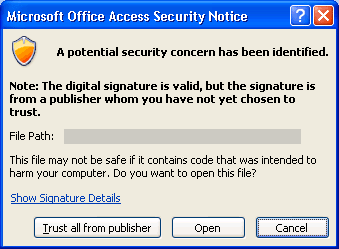
If you trust the database, click Open. If you trust whatever certificate from that provider, click Trust all from publisher. The Extract Database To dialog box appears.
-
-
Optionally, in the Save in list, select a location for the extracted database and then, in the File proper noun box, enter a different proper noun for the extracted database.
Top of Page
ACE no longer requires a separate installation to interact with non-Office apps
TBD
Top of Page
Space
Space
Space
Space
Space
Space
Space
Space
Space
Source: https://support.microsoft.com/en-us/office/deploy-an-access-application-7bb4f2ba-30ee-458c-a673-102dc34bf14f
0 Response to "What Is Used to Configure Data Sources for Applications That Require Access to a Database?"
Post a Comment