what act does criminal justice agencies have to worry about the most.

United states of america criminal justice system flowchart
Criminal justice is the delivery of justice to those who have been accused of committing crimes. The criminal justice organisation is a series of government agencies and institutions. Goals include the rehabilitation of offenders, preventing other crimes, and moral support for victims. The primary institutions of the criminal justice system are the police force, prosecution and defense force lawyers, the courts and prisons.
Constabulary [edit]
The Constabulary From Old English lagu (something laid downward or fixed) (Harper, Douglas. "law". Online Etymology Dictionary. ); legal comes from Latin legalis, from lex "police force", "statute" (Harper, Douglas. "legal". Online Etymology Dictionary. ) is a arrangement of rules usually enforced through a set of institutions. The purpose of police force is to provide an objective set of rules for governing conduct and maintaining social club in a club.
The oldest known codification law is the Code of Hammurabi, dating back to about 1754 BC. The preface direct credits the laws to the Code of Hammurabi of Ur. In unlike parts of the world, law could be established by philosophers or religion. In the modern globe, laws are typically created and enforced by governments. These codified laws may coexist with or contradict other forms of social command, such as religious proscriptions, professional rules and ethics, or the cultural mores and community of a lodge.
Inside the realm of codified law, there are by and large ii forms of police force that the courts are concerned with. Civil laws are rules and regulations which govern transactions and grievances betwixt individual citizens. Criminal police is concerned with actions which are dangerous or harmful to society as a whole, in which prosecution is pursued not by an individual but rather by the country. The purpose of criminal law is to provide the specific definition of what constitutes a crime and to prescribe punishments for committing such a crime. No criminal law can exist valid unless it includes both of these factors. The subject of criminal justice is primarily concerned with the enforcement of criminal law.
Criminal justice arrangement [edit]
Definition [edit]
The criminal justice system consists of 3 main parts:
- Law enforcement agencies, usually the police
- Courts and accompanying prosecution and defence lawyers
- Agencies for detaining and supervising offenders, such as prisons and probation agencies.
In the criminal justice organisation, these singled-out agencies operate together as the principal ways of maintaining the dominion of police within society.[1]
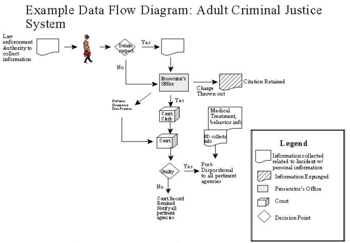
This image shows the procedure in the criminal justice system
Law enforcement [edit]
The first contact a defendant has with the criminal justice arrangement is unremarkably with the police force (or constabulary enforcement) who investigates the suspected wrongdoing and makes an abort, simply if the doubtable is unsafe to the whole nation, a national level law enforcement bureau is chosen in. When warranted, constabulary enforcement agencies or police force officers are empowered to use force and other forms of legal coercion and means to effect public and social guild. The term is most commonly associated with police force departments of a state that are authorized to exercise the police power of that state within a defined legal or territorial area of responsibility. The word comes from the Latin politia ("civil assistants"), which itself derives from the Ancient Greek πόλις, for polis ("city").[2] The starting time police force comparable to the nowadays-day police was established in 1667 under King Louis XIV in France, although modern police force usually trace their origins to the 1800 institution of the Thames River Constabulary in London, the Glasgow Police, and the Napoleonic constabulary of Paris.[3] [4] [5]
Constabulary are primarily concerned with keeping the peace and enforcing criminal police based on their particular mission and jurisdiction. Formed in 1908, the Federal Agency of Investigation began as an entity which could investigate and enforce specific federal laws as an investigative and "police force enforcement agency" in the U.s.a.;[vi] this, nevertheless, has constituted only a small-scale portion of overall policing action.[seven] Policing has included an assortment of activities in dissimilar contexts, merely the predominant ones are concerned with order maintenance and the provision of services.[8] During modernistic times, such endeavors contribute toward fulfilling a shared mission among law enforcement organizations with respect to the traditional policing mission of deterring criminal offence and maintaining societal order.[9]
Courts [edit]

The courts serve every bit the venue where disputes are settled and justice is so administered. With regard to criminal justice, in that location are a number of critical people in any courtroom setting. These disquisitional people are referred to as the court work group and include both professional and non professional individuals. These include the estimate, prosecutor, and the defense attorney. The guess, or magistrate, is a person, elected or appointed, who is knowledgeable in the law, and whose part is to considerately administer the legal proceedings and offer a final decision to dispose of a case.
In the U.S. and in a growing number of nations, guilt or innocence (although in the U.Southward. a jury can never observe a defendant "innocent" only rather "non guilty") is decided through the adversarial system. In this system, two parties will both offer their version of events and contend their instance earlier the court (sometimes earlier a estimate or panel of judges, sometimes before a jury). The example should exist decided in favor of the political party who offers the nigh sound and compelling arguments based on the law every bit applied to the facts of the case.
The prosecutor, or district attorney, is a lawyer who brings charges against a person, persons or corporate entity. Information technology is the prosecutor's duty to explain to the court what criminal offence was committed and to detail what prove has been constitute which incriminates the accused. The prosecutor should not be confused with a plaintiff or plaintiff'due south counsel. Although both serve the office of bringing a complaint before the court, the prosecutor is a retainer of the state who makes accusations on behalf of the state in criminal proceedings, while the plaintiff is the complaining party in civil proceedings.
A defense force chaser counsels the accused on the legal process, probable outcomes for the accused and suggests strategies. The accused, non the lawyer, has the right to make final decisions regarding a number of fundamental points, including whether to testify, and to accept a plea offering or demand a jury trial in advisable cases. It is the defense attorney'south duty to represent the interests of the client, enhance procedural and evidentiary issues, and concord the prosecution to its brunt of proving guilt beyond a reasonable doubt. Defense counsel may claiming evidence presented by the prosecution or present exculpatory evidence and argue on behalf of their client. At trial, the defense chaser may attempt to offer a rebuttal to the prosecutor'southward accusations.
In the U.Due south., an defendant person is entitled to a government-paid defense attorney if he or she is in jeopardy of losing his or her life and/or liberty. Those who cannot afford a private attorney may be provided one past the state. Historically, yet, the correct to a defense force attorney has not e'er been universal. For instance, in Tudor England criminals defendant of treason were non permitted to offer arguments in their defense. In many jurisdictions, there is no right to an appointed attorney, if the accused is not in jeopardy of losing his or her liberty.
The final decision of guilt or innocence is typically made past a third party, who is supposed to exist disinterested. This function may be performed by a gauge, a panel of judges, or a jury panel composed of unbiased citizens. This process varies depending on the laws of the specific jurisdiction. In some places the panel (be it judges or a jury) is required to issue a unanimous decision, while in others only a bulk vote is required. In America, this process depends on the state, level of court, and even agreements between the prosecuting and defending parties. Some nations practise not use juries at all, or rely on theological or war machine authorities to upshot verdicts.
Some cases can be disposed of without the need for a trial. In fact, the vast bulk are. If the accused confesses his or her guilt, a shorter procedure may exist employed and a judgment may be rendered more rapidly. Some nations, such as America, allow plea bargaining in which the defendant pleads guilty, nolo contendere or not guilty, and may have a diversion program or reduced penalization, where the prosecution's case is weak or in commutation for the cooperation of the accused against other people. This reduced sentence is sometimes a reward for sparing the state the expense of a formal trial. Many nations do not permit the apply of plea bargaining, believing that it coerces innocent people to plead guilty in an endeavor to avoid a harsh penalty. The courts nowadays are seeking culling measures every bit opposed to throwing someone into prison right away.[10]
The unabridged trial process, whatever the country, is fraught with problems and subject to criticism. Bias and discrimination class an ever-nowadays threat to an objective decision. Any prejudice on the part of the lawyers, the judge, or jury members threatens to destroy the court'southward credibility. Some people argue that the oft Byzantine rules governing courtroom bear and processes restrict a layman's ability to participate, essentially reducing the legal process to a boxing between the lawyers. In this example, the criticism is that the decision is based less on sound justice and more on the lawyer's eloquence and charisma. This is a detail problem when the lawyer performs in a substandard mode. The jury process is some other area of frequent criticism, equally at that place are few mechanisms to guard against poor judgment or incompetence on the part of the layman jurors. Judges themselves are very subject to bias bailiwick to things every bit ordinary as the length of time since their last break.[eleven]
Manipulations of the court system by defense and prosecution attorneys, law enforcement as well as the defendants take occurred and there have been cases where justice was denied.[12] [13]
Corrections and rehabilitation [edit]

Offenders are then turned over to the correctional government, from the court system after the defendant has been found guilty. Similar all other aspects of criminal justice, the administration of penalization has taken many different forms throughout history. Early on on, when civilizations lacked the resources necessary to construct and maintain prisons, exile and execution were the primary forms of punishment. Historically shame punishments and exile have also been used equally forms of censure.
The most publicly visible form of penalty in the modern era is the prison. Prisons may serve every bit detention centers for prisoners after trial. For containment of the accused, jails are used. Early prisons were used primarily to sequester criminals and little thought was given to living weather condition inside their walls. In America, the Quaker movement is ordinarily credited with establishing the idea that prisons should exist used to reform criminals. This can also be seen as a critical moment in the argue regarding the purpose of punishment.

Penalty (in the grade of prison fourth dimension) may serve a variety of purposes. First, and most manifestly, the incarceration of criminals removes them from the general population and inhibits their ability to perpetrate further crimes. A new goal of prison punishments is to offer criminals a chance to be rehabilitated. Many modernistic prisons offering schooling or job training to prisoners as a adventure to learn a vocation and thereby earn a legitimate living when they are returned to social club. Religious institutions likewise have a presence in many prisons, with the goal of teaching ethics and instilling a sense of morality in the prisoners. If a prisoner is released before his time is served, he is released as a parole. This means that they are released, but the restrictions are greater than that of someone on probation.
There are numerous other forms of penalization which are normally used in conjunction with or in place of prison terms. Budgetary fines are i of the oldest forms of punishment withal used today. These fines may be paid to the state or to the victims as a form of reparation. Probation and business firm abort are besides sanctions which seek to limit a person'due south mobility and his or her opportunities to commit crimes without actually placing them in a prison setting. Furthermore, many jurisdictions may require some grade of public or community service as a course of reparations for lesser offenses. In Corrections, the Department ensures court-ordered, pre-sentence chemical dependency assessments, related Drug Offender Sentencing Alternative specific examinations and treatment will occur for offenders sentenced to Drug Offender Sentencing Culling in compliance with RCW ix.94A.660.
Execution or death sentence is all the same used around the globe. Its use is one of the most heavily debated aspects of the criminal justice organisation. Some societies are willing to use executions as a form of political command, or for relatively pocket-size misdeeds. Other societies reserve execution for only the almost sinister and brutal offenses. Others even so have discontinued the practice entirely, accepting the apply of execution to be excessively roughshod and/or irreversible in case of an erroneous conviction.[14]
Academic discipline [edit]
The functional study of criminal justice is distinct from criminology, which involves the study of crime as a social miracle, causes of criminal offense, criminal beliefs, and other aspects of law-breaking. It emerged as an bookish subject field in the 1920s, starting time with Berkeley police chief August Vollmer who established a criminal justice program at the University of California, Berkeley in 1916.[xv] Vollmer's work was carried on by his pupil, O.Westward. Wilson, who led efforts to professionalize policing and reduce corruption. Other programs were established in the Usa at Indiana University, Michigan State University, San Jose State University, and the University of Washington.[sixteen] Equally of 1950, criminal justice students were estimated to number less than 1,000.[ commendation needed ] Until the 1960s, the chief focus of criminal justice in the United States was on policing and police science.
Throughout the 1960s and 1970s, crime rates soared and social issues took eye phase in the public centre. A number of new laws and studies focused federal resources on researching new approaches to crime control. The Warren Court (the Supreme Court nether Primary Justice Earl Warren), issued a series of rulings which redefined denizen's rights and substantially altered the powers and responsibilities of police and the courts. The Civil Rights Era offered significant legal and ethical challenges to the status quo.
In the late 1960s, with the institution of the Police Enforcement Assistance Administration (LEAA) and associated policy changes that resulted with the Omnibus Crime Control and Rubber Streets Human action of 1968. The LEAA provided grants for criminology enquiry, focusing on social aspects of criminal offence. By the 1970s, there were 729 academic programs in criminology and criminal justice in the Usa.[16] Largely thanks to the Police Enforcement Education Program, criminal justice students numbered over 100,000 past 1975. Over fourth dimension, scholars of criminal justice began to include criminology, sociology, and psychology, amidst others, to provide a more comprehensive view of the criminal justice organisation and the root causes of crime. Criminal justice studies now combine the practical and technical policing skills with a written report of social deviance as a whole.
Criminal justice caste programs at four-year institutions typically include coursework in statistics, methods of research, criminal justice, policing, U.S court systems, criminal courts, corrections, customs corrections, criminal procedure, criminal law, victimology, juvenile justice, and a diverseness of special topics. A number of universities offering a Available of Criminal Justice.
History [edit]
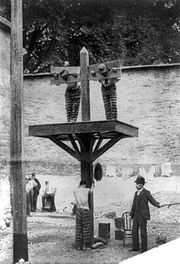
The modern criminal justice system has evolved since ancient times, with new forms of punishment, added rights for offenders and victims, and policing reforms. These developments have reflected changing community, political ideals, and economic conditions. In ancient times through the Heart Ages, exile was a common grade of punishment. During the Middle Ages, payment to the victim (or the victim's family unit), known every bit wergild, was another mutual punishment, including for violent crimes. For those who could not afford to buy their way out of punishment, harsh penalties included various forms of corporal penalisation. These included mutilation, branding, and flogging, equally well every bit execution.[ citation needed ]
Though a prison house, Le Stinche, existed as early as the 14th century in Florence,[17] incarceration was not widely used until the 19th century. Correctional reform in the The states was first initiated by William Penn, towards the end of the 17th century. For a time, Pennsylvania's criminal code was revised to foreclose torture and other forms of barbarous penalty, with jails and prisons replacing corporal punishment. These reforms were reverted, upon Penn's decease in 1718. Nether force per unit area from a group of Quakers, these reforms were revived in Pennsylvania toward the end of the 18th century, and led to a marked drop in Pennsylvania's criminal offense rate. Patrick Colquhoun, Henry Fielding and others led significant reforms during the late eighteenth and early nineteenth centuries.[18]
The evolution of a modern criminal justice system was gimmicky to the formation of the concept of a nation-land, later on defined past German sociologist Max Weber every bit establishing a "monopoly on the legitimate use of physical force", which was exercised in the criminal justice case by the police.[nineteen] [xx] [21] [22]
Modernistic police [edit]
The beginning modern police force forcefulness is normally said to exist the Metropolitan Police force in London, established in 1829 past Sir Robert Peel.[23] [24] Based on the Peelian principles, information technology promoted the preventive function of constabulary every bit a deterrent to urban crime and disorder.[25] [26] In the United states of america, police departments were first established in Boston in 1838, and New York City in 1844. Early, police were not respected by the community, every bit abuse was rampant.
In the 1920s, led by Berkeley, California, police chief, Baronial Vollmer and O.Westward. Wilson, police force began to professionalize, prefer new technologies, and place emphasis on training and professional person qualifications of new hires. Despite such reforms, police force agencies were led by highly autocratic leaders, and there remained a lack of respect between police and the community. Following urban unrest in the 1960s, police placed more emphasis on customs relations, enacted reforms such as increased diversity in hiring, and many police agencies adopted community policing strategies.
In the 1990s, CompStat was developed by the New York Police Section as an information-based system for tracking and mapping crime patterns and trends, and belongings law accountable for dealing with crime problems. CompStat has since been replicated in law departments across the U.s.a. and around the world, with problem-oriented policing, intelligence-led policing, and other information-led policing strategies also adopted.
Run into also [edit]
- Outline of criminal justice – structured list of topics related to criminal justice, organized past subject area
- Criminal justice ideals
- Criminal justice reform
- Academy of Criminal Justice Sciences
- Criminal responsibility in French constabulary
- American Society of Criminology
- Prison reform
- Public criminology
- Backsliding
- Restorative justice
References [edit]
- ^ "U.S. Criminal Justice System Overview - CorrectionalOfficer.org". www.correctionalofficer.org.
- ^ Harper, Douglas. "law". Online Etymology Lexicon . Retrieved 2007-02-08 .
- ^ Dinsmor, Alastair (Winter 2003). "Glasgow Police Pioneers". The Scotia News. Archived from the original on 2009-07-16. Retrieved 2007-01-ten .
- ^ "History". Marine Support Unit. Metropolitan Law. Archived from the original on 2007-07-xvi. Retrieved 2007-02-10 .
- ^ "La Lieutenance Générale de Law". La Préfecture de Police fête ses 200 ans Juillet 1800 - Juillet 2000 (in French). La Préfecture de Police force au service des Parisiens. Archived from the original on November 22, 2001.
- ^ FBI (2009). THE FBI: A Centennial History, 1908-2008. Washington, D.C.: FBI. p. 138. ISBN978-0-16-080954-5.
- ^ Walker, Samuel (1977). A Critical History of Police Reform: The Emergence of Professionalism. Lexington, MT: Lexington Books. p. 143. ISBN978-0-669-01292-vii.
- ^ Neocleous, Marker (2004). Fabricating Social Guild: A Disquisitional History of Police Power. London: Pluto Press. pp. 93–94. ISBN.
- ^ McElreath, David; Doss, Daniel; Jensen, Carl; Wigginton, Michael; Kennedy, Ralph; Winter, Kenneth; Mongue, Robert; Bounds, Janice; Estis-Sumerel, J. Michelle (2013). Introduction to Law Enforcement (ane ed.). Boca Raton, Florida: CRC Press. p. 87. ISBN978-1466556232.
- ^ Rios, Victor (2011). Punished. p. 108.
- ^ "We find that the percentage of favorable rulings drops gradually from ≈65% to about zippo within each conclusion session and returns abruptly to ≈65% after a suspension." Shai Danzigera; Jonathan Levav; Liora Avnaim-Pessoa (11 April 2011). "Inapplicable factors in judicial decisions". Proceedings of the National University of Sciences of the Usa of America. 108 (17): 6889–92. Bibcode:2011PNAS..108.6889D. doi:10.1073/pnas.1018033108. PMC3084045. PMID 21482790.
- ^ Perri, Frank S.; Lichtenwald, Terrance G. (2009). "When Worlds Collide: Criminal Investigative Analysis, Forensic Psychology And the Timothy Masters Example" (PDF). Forensic Examiner. 18 (2): 226972.
- ^ Perri, Frank S.; Lichtenwald, Terrance One thousand. (2010). "The Last Frontier: Myths & The Female Psychopathic Killer" (PDF). Forensic Examiner. xix (2): 50–67.
- ^ (ACJS) 1963 Justice Sciences 2015-04-25. 2015-05-07 ACJS History 243-252 Criminal Justice. 4: 243-2546790
- ^ "Finest of the Finest". Time. February 18, 1966. Archived from the original on 2008-ten-xiv.
- ^ a b Savelsberg, Joachim J., Lara L. Cleveland, Ryan D. Rex; Cleveland; King (June 2004). "Institutional Environments and Scholarly Piece of work: American Criminology, 1951-1993". Social Forces. 82 (4): 1275–1302. doi:10.1353/sof.2004.0093. S2CID 145220713.
{{cite periodical}}: CS1 maint: multiple names: authors list (link) - ^ Wolfgang, Marvin (1990). "Law-breaking and Punishment in Renaissance Florence". Journal of Criminal Police force and Criminology. 81 (iii): 567–84. doi:10.2307/1143848. JSTOR 1143848.
- ^ Garland, David (2002). "Of Crimes and Criminals". In Maguire, Mike; Rod Morgan; Robert Reiner (eds.). The Oxford Handbook of Criminology, 3rd edition. Oxford Academy Press. p. 20.
- ^ Max Weber, Weber's Rationalism and Modern Lodge, translated and edited by Tony Waters and Dagmar Waters. New York: Palgrave Books, 2015, pp. 129-198.
- ^ Max Weber in Weber's Rationalism and Mod Society, translated and edited by Tony Waters and Dagmar Waters. Palgrave Books 2015, p. 136
- ^ Bates, R.; Greif, A.; Singh, S. (2002). "Organizing Violence". Periodical of Disharmonize Resolution. 46 (5): 599–628. doi:10.1177/002200202236166. S2CID 14970734.
- ^ Olson, Mancur (1993). "Dictatorship, Democracy, and Evolution". American Political Scientific discipline Review. September 1993 (iii): 567–576. doi:ten.2307/2938736. JSTOR 2938736.
- ^ Terrill, Richard J. (2015). World Criminal Justice Systems: A Comparative Survey (revised ed.). Routledge. p. 32. ISBN978-1317228820.
- ^ Dempsey, John S.; Forst, Linda S. (2015). An Introduction to Policing (eight ed.). Cengage Learning. pp. 6–8. ISBN978-1305544680.
- ^ Brodeur, Jean-Paul (1983). "High Policing and Low Policing: Remarks near the Policing of Political Activities". Social Problems. 30 (5): 507–520. doi:10.2307/800268. JSTOR 800268. Retrieved twenty Baronial 2021.
- ^ "Policing by consent". Britain Government. 10 Dec 2012. Retrieved 29 December 2013.
Farther reading [edit]
- Dale, Elizabeth. Criminal Justice in the United States, 1789–1939 (Cambridge University Printing, 2011)184 pp
- Fuller, John Randolph. Criminal Justice: Mainstream and Crosscurrents 2005. Prentice Hall. Upper Saddle River, NJ.
- Serge Guinchard and Jacques Buisson. Criminal procedural law in French republic Lexinexis editor, 7th edition, September 2011, 1584 pages.
- Hanes, Richard C. and Sharon M. Hanes. Offense and Punishment in America. Book 1. 2005. Thomas Gale. Farmington Hills, MI
- Friedman, Lawrence M. Offense and Punishment in American History. 1993. Basic Books. New York, NY.
- Sunga, Lyal S. The Emerging System of International Criminal Law: Developments in Codified and Implementation. 1997. Kluwer Law International. The Hague, Holland.
- Walker, Samuel Popular Justice: A History of American Criminal Justice. 1980. Oxford Academy Press, Inc. New York
External links [edit]
- Academy of Criminal Justice Sciences
- The International Middle for Transitional Justice's (ICTJ) Criminal Justice Page
- Scottish Middle for Crime and Justice Research, a well-respected bookish enquiry centre focusing on crime and justice problems.
Source: https://en.wikipedia.org/wiki/Criminal_justice
0 Response to "what act does criminal justice agencies have to worry about the most."
Post a Comment