The Ruling Royal Family of a European Country Fled to What Colony to Protect Its Dynasty?
The British Empire was the biggest in earth history – and there's a reason why it was nicknamed the 'empire on which the sunday never sets.'
At its peak, the British Empire covered nearly a quarter of the globe, dominating some xx-three percent of the globe's population. That seems like quite a lot of territory and is renowned for a tiny little isle on the corner of Europe.
It'south time to become to grips with the British Empire: with how information technology originated, weakened and fell, and how it changed the world that we live in now.
If you are studying for the AQA A level in The British Empire, this is the place to come – simply fifty-fifty if you lot are just interested in what this controversial global system was all about, then yous are more than than welcome too.

The best History tutors bachelor


1st lesson free!

1st lesson free!

onest lesson free!

onest lesson complimentary!

1st lesson gratuitous!

anest lesson free!

1st lesson free!

anest lesson free!
1st lesson gratuitous!
ist lesson free!
1st lesson free!
1st lesson free!
1st lesson free!
anest lesson complimentary!
1st lesson costless!
1st lesson costless!
What countries were included within the British Empire?
Often the British Empire is actually split into two by historians: the First British Empire and the 2d.

The first takes usa from the first colonies in the 'New World' at the turn of the sixteenth century to the loss of the United States every bit a colonial territory in 1783. The Second sees Uk responding by focusing more than on the Pacific, gaining land in India, Commonwealth of australia, and New Zealand.
Throughout the menses, Britain had major territories in Africa, too.
Further in this article, we delve deeper into the Outset and 2nd Empires. Afterward, we'll talk about why and how Great Uk's imperial might waned in the twentieth century.
Some historians bespeak to the end of the Second World War, which triggered a wave of independence movements across the Empire, whilst others say that the Empire formally concluded in 1997, when Hong Kong was returned to China.
The Origins of the British Empire
Tardily in the sixteenth century, the Spanish and Portuguese returned from explorations in the New Globe, basking in the wealth of spoils they amassed and the prestige information technology brought. Before long, other important European powers – France, the Netherlands, and England – wanted in on the action.
That is when British imperial activity began.
Elizabeth I instituted a policy of exploration in the Americas and ordered engagement in naval conflicts with the Castilian. People similar Walter Raleigh and Francis Drake rivalled pirates in their looting of spoils of Spanish discoveries. They also tried to establish colonies of their own.
In the last years of Elizabeth's reign, in 1601, after many previous attempts, England conquered Ireland. This began the slow process of importing Protestant Englishmen and Scots to the Catholic island.
At the outset of James I'due south reign, England signed a treaty with Spain. The burgeoning empire turned west; the English language became less focused on attacking their Iberian rivals, instead, they moved to establish colonial settlements in North America and the Caribbean area.
In one case those colonies in that location were established, the English barred whatsoever transport other than the British to make port. This policy of isolation was meant to secure all possible profits from the territories but it displeased United kingdom's rivals.
The subsequent naval wars with the Dutch, whilst ostensibly lost by the Brits, ultimately laid the conditions for British authorisation. The Brits, for example, gained Dutch territory – including New York in the 1665-7 Anglo-Dutch state of war – but, after the Glorious Revolution of 1688, the two countries signed a truce.

The "First" British Empire (1707-1783)
When the sun first rose on the British Empire, U.k. was embroiled in the War of Spanish Succession, fighting alongside the Dutch, Portuguese and Romans - who, at that fourth dimension, were still regal.
That war ended in 1714 when Spanish king Philip V relinquished his successors' claim on the French throne.
Once the Treaty of Utrecht was signed, France bequeathed Newfoundland and Acadia to England and Spain ceded them Gibraltar and Minorca. Gibraltar was an especially meaning gain because it afforded Britain control over access to the Mediterranean.
One more bequest from the Spanish to the British kingdom: control over its African slave merchandise, a particularly lucrative revenue stream that helped finance British exploits in the Americas.
The articulation conquest of the Castilian war machine in Europe and the subsequent payment of reparations does non mean that, henceforth, all would be well between the waning empire (Spain) and the waxing one (England).
The Rex of Spain failed to retake Gibraltar during the two-year Anglo-Spanish War (1727-1729) and so, when the Spaniards had a chance to strike back - not in battle but by seizing all British ships docked in New Kingdom of spain ports, they did non hesitate to practise so.
You might know that New Kingdom of spain is comprised of territories in the Americas, the Caribbean area and even equally far abroad as Asia and Oceania.
Thereafter ensued a string of piddling attacks past the Spanish. Nothing that could exist called combat; more like costly annoyances. Costly for the British, of class.
It wasn't until 1746 that the British and Castilian engaged in peace talks. The Spanish rex agreed to stop attacking British ships just, in render, Britain lost the slave-trading rights they had been given as reparations 35 years before.
Meanwhile, in the East Indies...
The competition was fierce: the Dutch and British companies constantly tried to outdo each other in trade and conquering. The two main markets were for spices and textiles and, with the latter gaining in trade volume, the British eventually outpaced their competitors.
That doesn't mean that, strategically, they were peerless.
Besides several military conflicts, among them the Carnatic Wars, British traders and crown representatives remained locked in trigger-happy competition with the French to fill up the power vacuum left past the collapse of the Mughal Empire.
It wasn't until 1757 that the British Eastward India Company gained control of India, the about valuable territory that they owned.
Led by Robert Clive - Clive of Bharat, every bit he is also known, the British triumphed over the French in the Battle of Plassey, giving the British full military and political command over Bharat. However, the French and British - and other European powers connected to struggle, most notably in the 7 Years' War (1756-63).
The Treaty of Paris signing in 1763 concluded any claims the French might make on whatsoever of their colonial territories, which comprised of big swaths of state in North America. Adding them to the victories in Republic of india made Britain the earth'due south largest maritime ability.
Find proficient history tutor here on Superprof.
How Did Britain Lose the Xiii American Colonies?
While non exactly on top of the globe, the British Empire commanded a substantial portion of it and none was quite as promising as the colonies established in North America.
By 1763, the British Empire had laid claim to about ane-tertiary of what is now known as the Us, plus two-thirds of what would become Canada and territories in South America, too. However, the settlers in the initial xiii established colonies chafed under Britain's violation of their rights as Englishmen.
Colonists were forced to pay taxes to their homeland while having no voice in the British Parliament. Their grievance of tax without representation started the American Revolution, in which colonists first bandage off parliamentary rule, and and then established a authorities of their ain.
The British Empire pushed back by sending troops and politicians over to re-establish dominion; a motility that led to outright war. Unfortunately for the newly-arrived British, they were confronted not just with renegade colonists but with their erstwhile nemeses, French republic and Spain.
Almost as soon equally the Continental Army was established in 1776, the French sent over supplies and money to purchase what weapons they could.
While the French provided logistic and financial back up, the Spaniards joined in the fighting, attacking British troops in what is at present known as Florida and fighting battles upwardly the declension.
Not to be outdone, the Dutch joined in the fray, but not to help out the colonists even though they too had been helping to outfit and supply the Continental Regular army. The British were dissatisfied with the Dutch trading with their enemies - the French, Castilian and colonists.
Those squabbles turned into a full-fledged war, fought between the Dutch and the British, all while The Crown's troops were trying to regain control of their territories and people. It was a lone battle - the British had no allies to fight alongside them, and fighting two wars at the same time shortly depleted what reserves they had, of troops and supplies.
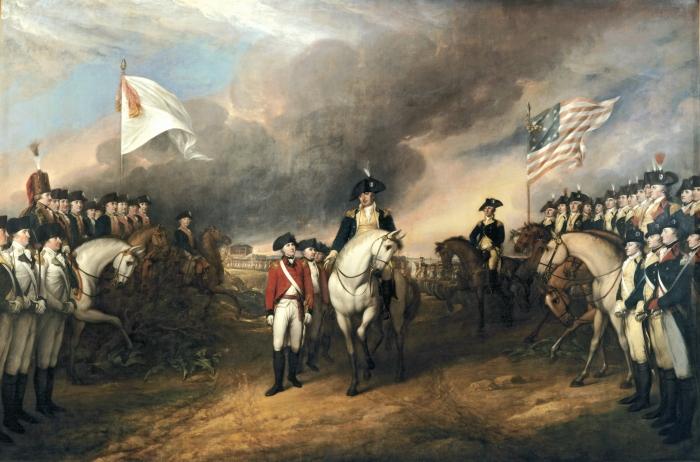
The Battle of Yorktown (1781) delivered a decisive win to the Americans. Britain negotiated a peace treaty, declaring America an contained nation in the Peace of Paris agreements.
The loss of such a large and populous territory marked the end of the Offset British Empire.
The all-time History tutors available
1st lesson gratis!
onest lesson free!
1st lesson gratis!
1st lesson free!
1st lesson free!
1st lesson costless!
anest lesson free!
1st lesson costless!
onest lesson gratuitous!
1st lesson complimentary!
ist lesson gratuitous!
1st lesson free!
anest lesson free!
1st lesson free!
1st lesson free!
anest lesson free!
The Peak of British Command
The height of the British Empire was between 1815 and 1914 – and it has been called 'The British Century'. This was the period after American independence, but when Britain all the same had more territory than ever – every bit Independence inspired further British expansion into the Pacific and Due east Asia.
As we come across with the Mongol and Roman Empires, there became something of a Pax Britannica – a peace throughout the areas owned by Britain – due to the unassailable authority of the British. Throughout the areas endemic past the Empire, merchandise flourished.
The Navy
Unlike other major empires – the Russian Empire, the Mongol Empire, and the Qing Dynasty – British imperialism was facilitated through the ocean. The British Navy was the biggest to always have existed, and its ability led to the conquests that developed into the empire – hence that famous song, 'Britannia Rules the Waves'.
Earth Merchandise
Whilst many of the colonies were, in their own right, immensely valuable to the British – for their resources, their industries, their manpower – many were also founded to facilitate more hands global merchandise routes. Further, oftentimes trade companies were the main drivers of imperialism.
For example, information technology was the East India Company that established the colony in Bharat – with the assistance of the navy – whilst the Cape Company fought with the Dutch in South Africa precisely because the 'Greatcoat' provided a stopping place on the way to the Pacific from the Atlantic. The intersection of individual trade and government power is well shown by the instance of Cecil Rhodes, the businessman, miner, and diamond trader, who became prime number minister of S Africa and after whom Rhodesia was named.
Industrial Revolution
Throughout the nineteenth century, developments in the industry made Britain 'the workshop of the world': its trade and manufactured appurtenances dominated the world, as they were produced cheaply and quickly, and were distributed easily, due to the combination of the British Navy and the industrial revolution at home.
The wealth and resource that permitted this development often came from the colonies, such equally the Indian textile industry.
The Second British Empire
Afterward losing the American colonies, the British pivoted to Asia and the Pacific in general; afterwards they gained territory in Africa. These new explorations and acquisitions were in part funded past the trade policies established with America, which proved to be a far greater economic boon than first expected.
One downside to losing the American colonies is that the British had nowhere to ship convicts to. Since 1718, criminals of all stripes had been shipped off to the colonies to serve their sentence; a relatively short journey across the Atlantic.
Australia became Britain's new penal colony.
It had already been discovered and claimed by the Dutch in 1660 only they made no motion to colonise it so, when Helm James Cook landed on its eastern shores in 1770, he promptly named it New S Wales and declared it suitable for prisoners.
Botany Bay became the first penal colony; others soon followed - and they turned a hefty profit for the Empire. Starting time with shipments of wool and later, when gold was discovered in Victoria. Thanks to this gilded blitz, Melbourne became the second-richest city in the globe after London.
Captain Cook likewise explored the north and south islands of New Zealand, quickly claiming them in The Crown's name and working out trade agreements with the Maori tribes. Presently, Europeans established colonies and businesses, the most lucrative of which was the New Zealand Trading Company, founded in 1839.
This company bought up substantial parcels of land; a yr later, William Hobson signed the Treaty of Waitangi with over forty Maori chiefs. Captain Hobson would become the first governor of New Zealand and the treaty he drafted and signed became the nation's founding document.
Despite Great britain'due south Australian and New Zealand's country grabs that went virtually unchallenged, it was non smooth sailing for The Empire.
Napoleon Bonaparte had come into power in France and he was set up to challenge the British Empire - not merely her military might but her very ideology. This was a fight that Britain could not afford to lose; The Empire had no desire to be overrun by the atomic dictator, a fate so many other countries in Europe had suffered.
The full contents of Britain'south state of war chest were disbursed in the effort to stave off invasion and the most cunning military machine strategies were put into activity.
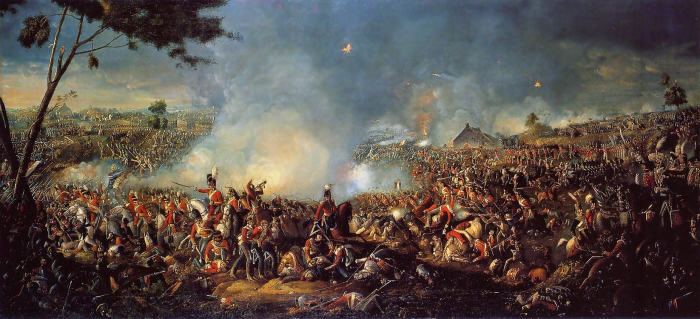
The Royal Navy blockaded French ports; they then went on to defeat the unabridged Franco-Spanish naval fleet in the Battle of Trafalgar (1805). However, Napoleon's armies moved fast and, while winning this boxing, others raged on.
Napoleon seized other territories and colonies; it took the combined might of European military machine forces to finally defeat him in 1815.
Once more, the British Empire enjoyed the spoils of war, reaping Malta, the Ionian Islands, Seychelles, Mauritius, Santa Lucia and Tobago from the French. The Spaniards ceded Trinidad and the netherlands handed over the Cape Colony and Republic of guyana, Ceylon and Heligoland.
These gains were somewhat offset by The Empire returning French Guiana, Martinique, Guadeloupe and Reunion to France, and Suriname and Coffee to the Dutch.
Conflict and Controversy
The assistants and processes of the British Empire were not often peculiarly well-received, past either the colonists who had set upwardly residence in the provinces or the native populations over which the Empire dominated. The issue of slavery is perhaps the most controversial of all.
American War of Independence
The American Revolutionary War (1775-1783) shows how the resentment of the colonies caused problems for the Empire. This war allowed the Thirteen Colonies, which became the United States, to gain independence from Britain. In the war, they allied with France, which were eager to maintain their properties in that function of the world and to stymie British authorization.
The spark of the revolution was taxation. The colonies were required to pay taxes to U.k., but they were not represented politically in Parliament. The issue of democracy was central here.
Slavery and Racism
In contexts, such equally Bharat, where the native population was not destroyed by the colonists, the royal government frequently used native upper classes to rule nether the control of the British.
However, the often outright racism of the Empire is nigh evident in the Royal African Company. This was established in 1672 to take slaves from Africa to the Caribbean. The company carried approximately three.5 million slaves across the Atlantic until 1807, to work primarily on plantations.
Colonialism and the Slave Trade
With colonies spread across the earth and work needing to exist done, the British made hefty utilise of slaves.
They had discovered how lucrative the slave trade could be in the early days of the First Empire; soon they discovered how cost-effective using slave labour on remote plantations and in other industries was. That'southward the rosy picture.
The reality was that slave rebellions were getting more costly to suppress and, likewise, with the Industrial Revolution fully underway, at that place was less of a need for slaves but the issue of slaves did not truly come under fire until the Abolitionist Motility gained traction in Parliament.
Religious groups had been condemning slavery for well over a century, entreating that enslaving people was a fundamental violation of the 'rights of man'.
While England itself had banned slavery in 1102, there was no prohibition about aircraft slaves to the colonies. This do went on for centuries, until the Slave Trade Act, which banned all slave trade throughout the empire, was signed into police by Parliament in 1807.
The following year, the Sierra Leone Colony was founded as a freed slave enclave simply it was poorly populated until the Slave Abolition Act was ratified in 1834.
The original deed meant that, while humans would no longer be traded, it was still legal to keep the slaves one already endemic. It wasn't until the second act was passed into law that the practice of slavery ended throughout the British Empire.
While it may have been wonderful for the enslaved to be free, the question for former slave owners was what to practise with all of the people formerly considered possessions.
Early on afterward the abolition act was signed, slave owners instituted a form of apprenticeship that lasted anywhere between four and six years, ostensibly to teach emancipated slaves a trade.
This caused such outrage among the abolitionists - they saw information technology every bit a style to extend the practice of slavery under a different name, that the apprenticeship programme was abolished in 1838, soon later on it started.

Globe Wars and British Imperial Decline
The World Wars
As happens with all empires somewhen, the British Empire began to decline – during the twentieth century. Whilst they won both earth wars, Britain was severely weakened and financially drained. With the rising of Germany, and the Ottoman Empire fighting the Russian Empire, the First World State of war had been an explicitly imperialist war.
World War Two was a truly world war, with the purple countries demanding the contribution of troops from the colonies. In the far east during the Second Globe War, Japan had invaded British territories and had shown that their authorization was not absolute. The Japanese had also spread anti-British sentiment amid the territories they controlled.
Independence Movements and Decolonisation
After the 2 wars, the combination of the weaknesses of the British government and the growth of nationalism globally meant that disillusion with imperialism was felt at home and abroad throughout the twentieth century.
Post-obit a massive rebellion and peaceful defection led by the nationalist Mahatma Gandhi, Indian independence was granted in 1947 – signed by the regime of Clement Attlee. This loss of the biggest of British territories sparked 20 years of quick independence movements.
The British withdrew in 1948 from Palestine, after Jewish terrorism demanding independence – and the country of Israel was declared soon afterward. Shortly afterwards, the Suez crunch of 1956 showed that United kingdom was no longer the power that information technology had been – every bit a war machine strategy ended in embarrassment without the help of the U.s..
In Africa, Britain hoped to avoid the situation suffered by the French in Algeria: a long and brutal war of independence. Great britain pursued decolonisation peacefully, with about thirty African territories being granted independence in the sixties. But Rhodesia remained technically a office of the empire if a territory with self-authorities – until the eighties.
The end of the British Empire is frequently considered to be 1997 when Britain returned Hong Kong to Mainland china.
The British Empire Today
A Problematic Legacy
These days, Britain's imperial by is controversial – with some considering it with pride and others identifying the bug of racism and the domination of unlike indigenous and political identities.
Colonialism was essentially a fierce phenomenon, which used racist ideas to justify the plunder and command of resources. Critics indicate out that U.k. built its wealth from the impoverishment of other countries.
These days, nosotros can see the importance of the British Empire across the world by the fact that many people speak English. The Commonwealth of Nations is another legacy of empire – the cooperation and association of 53 states that were previously British colonies.
Find out more about the swell empires of the world in our series on the subject!
Source: https://www.superprof.co.uk/blog/british-empire-history/
0 Response to "The Ruling Royal Family of a European Country Fled to What Colony to Protect Its Dynasty?"
Post a Comment