How to Get Your First Multi Family Property
My first rental property was a small two-unit property, a duplex, that I bought when I was 21. Later I bought some other duplex, a triplex, some fourplexes, some apartments, and some mobile dwelling parks. Now I take more than 2,000 rental units across a dozen states—most all multifamily. This allows me to alive where I want, pay all my bills, requite generously, and work far fewer hours than most.
That's the power of multifamily existent estate.
Investing in multifamily backdrop tin change your life, whether you desire simply a few modest deals or a real manor empire. Information technology's similar to investing in unmarried-family houses, but instead of shopping at Walmart, you're at Costco. You're buying in bulk, and can quickly scale upward your passive income and net worth faster than you think possible. And hey, information technology'due south a lot of fun!
Simply stated, multifamily backdrop are one of the easiest means to climb your way to millions of dollars in real estate and requite y'all the life y'all've dreamed of.
And the nifty thing is that anyone can invest in multifamily, regardless of your location, income, credit, experience, or banking concern account—if y'all know what yous're doing.
What is a multifamily holding?
To put it simply, a multifamily dwelling house is whatever residential property that features more than ane housing unit.
These could exist duplexes, triplexes, fourplexes, flat complexes, or really anything that involves multiple tenants living in occupied units on one property. Owners can live in whatsoever of these units besides, which would go far an owner-occupied property—something we call "house hacking," which is typically done with residential multifamily backdrop with two, three, or iv total units.
Properties with more than four units are deemed commercial, while four and below are deemed residential. This stardom is important for lending purposes, as the lending rules for residential multifamily differ from the lending rules for commercial investments.
In addition to the lending distinction, larger multifamily properties may also have dissimilar methods for finding, analyzing, financing, and managing the holding. For this reason, almost investors getting into multifamily start with small residential properties and move into the larger multifamily deals once they've gained some experience.
Now, let's become over how astonishing these properties are and why you lot need them in your portfolio.
The power of the multifamily property
I honey multifamily for a lot of reasons. Only since you don't want to spend the next three hours reading while I lay them all out, let me but give you four skilful ones.
1. Cash catamenia
Cash flow is the proper noun of the game in existent manor investing. When trying to get the most bang for your buck, purchasing multifamily homes is a great grade to take. Why? Because multifamily backdrop are designed for cash flow.
Call back almost it. When someone builds a house, what's usually the purpose? For someone to live in for themselves.
A unmarried-family unit dwelling house is not designed for cash menses, but for condolement (yes, unmarried-family homes can however cash flow—it'south just harder because they aren't designed for it). Multifamily, on the other hand, is generally built and sold for investment purposes. In other words, it's designed to make cash catamenia.
Be careful, though. But because it's a multifamily holding doesn't hateful it'southward going to cash menses. There are many different factors that determine ane's monthly greenbacks menses. There's the mortgage payment, insurance costs, property taxes, utilities, repairs, management, saving up for replacing big items (which we call "CapEx" in the real estate world), and more.
2. Quick portfolio expansion
Wealth is non built by purchasing a property, only by edifice a portfolio. In other words, it's not ane bargain that'south going to get yous the wealth and freedom y'all want, just the collection of many rental units.
Certain, you tin can buy a house every twelvemonth or two, but that's a slow path toward generating enough greenbacks flow to quit your job, travel the world, purchase a Tesla, or whatever your goal is. Multifamily properties, on the other hand, tin can automatically add numerous rental units to your portfolio at in one case, helping you scale fast.
3. Reduced risk
When yous own a firm and that house goes vacant, you're 100% vacant, earning no money from that unit. Simply if you own multifamily backdrop, if one unit needs repairs or is vacant, yous have other units that can carry its slack for the time being. That makes multifamily units a very powerful asset, especially for a beginning investor.
4. Potential for house hacking
Finally, at that place'due south the power of firm hacking, the process by which you'll live in one unit of measurement and hire the other units out. Multifamily makes this possible!
For instance, let's say you purchase a triplex and your monthly mortgage payment for the property equally a whole is $1,500. Y'all rent out two of the units for $650 and go along one for yourself. Your individual mortgage payment is $200 per month. That'south a bargain!
Finding multifamily properties
The showtime step in finding multifamily properties is to clearly define what type of multifamily you desire. In The Multifamily Millionaire, I suspension downward this step into something I call your "crystal clear criteria," which includes defining the following.
- Property type: Small multifamily? Medium-sized? Large?
- Location: Where can yous build expertise nearly an area?
- Condition: Exercise you want a projection or something already finished?
- Price range: Is this a $200,000 property or a $200,000,000 property?
- Profitability: What kind of financial return are you looking for?
Once you've divers exactly what you're looking for, you tin better hunt for those deals.
However, this is where we need to look at another divergence betwixt small multifamily and large multifamily.
Small multifamily deals are ordinarily sold through real estate agents. You tin can search for them on websites similar Realtor.com or Zillow, or fifty-fifty improve, get yourself a rock star real manor agent who understands real manor investing to help you get those leads automatically.
It'due south too possible to find these pocket-sized multifamily deals off-market, pregnant you direct market to owners of multifamily properties in the hopes of convincing them to sell you their property earlier they list with an agent. In that location are numerous off-market place deal-finding strategies, but the most common are direct mail marketing, driving for dollars, and networking with owners or wholesalers.
When it comes to larger multifamily properties, while the same off-market place strategies do exist and can work, most of the sales happen through commercial real estate brokers.
These brokers are constantly networking with multifamily owners. When an owner decides to sell, the brokers will put together a fancy sales parcel and attempt to find a buyer for that deal through their heir-apparent clients. If they can't notice a buyer straight through their personal network, they may list the holding for auction online through a commercial real estate sales portal such as Loopnet or Crexi, which you can visit as well to look through potential deals.
The key to finding multifamily properties is creating a consequent funnel of leads to pursue, and then running the numbers to observe out just how much you can afford to offering. Simply how exercise we "run the numbers?"

Grow your portfolio with multifamily
Multifamily existent estate investing can turn anyone into a multimillionaire—but only if you run your business the correct way! In this two-volume set up, The Multifamily Millionaire, authors Brandon Turner and Brian Murray share the exact pattern you demand to get started with multifamily real estate.
Analyzing multifamily properties
I oftentimes say that deal analysis is the number i almost important skill an investor can accept. When y'all know how to do the math, you'll avoid buying bad deals, take an easier time using other people's money to purchase those good deals, and achieve your fiscal goals faster with far less risk.
Just non everyone likes math, and understandably and then. It tin get actually complicated, especially with multifamily.
Unfortunately, nevertheless, it's hard to make skillful investments without crunching numbers. After all, investing is just i big equation. Rather than proverb, "I don't know how to practise the math, so I'll just wing information technology," allow'south take the time to learn.
Experienced multifamily investors typically favor the term "underwriting" instead of "analysis." They are basically the same concept, just underwriting is the manufacture term then be sure to employ information technology if you desire to look smart.
Underwriting really involves ii distinct parts.
- The collection of information (income, expenses, etc.)
- The actual mathematical analysis.
Collecting the data
When I say "collecting the data," what I'm referring to is getting a solid understanding of what exactly you are dealing with.
- What's the location similar?
- How many units are in the holding?
- What do those units hire for?
- Are there other sources of income, like laundry machines or rented storage?
- Which utilities are paid by the landlord, and which are paid past the tenants?
- What'southward the status of the property?
- How much are the property taxes—and how much will they be after closing?
- How much will insurance price?
- What other expenses will the landlord be responsible for?
Most of these data points can be learned past talking with the banker involved in the auction, or by asking pointed questions of the seller. Additionally, at least for on-market, listed properties, the broker will get together this data ahead of fourth dimension and place information technology into the sales document. But be warned—these sales documents are meant to sell you on the deal, and so never trust them. Verify each point to exist sure it's non an overly optimistic estimate or flat-out lie.
The cardinal to data collection is wrapping your head around the entire projection and so you can make the all-time-informed underwriting. You wouldn't want to purchase a multifamily belongings only to find out later on that the city has a special monthly fee that'due south going to cost you thousands of dollars a yr.
In simply a moment, we're going to be analyzing a hypothetical multifamily deal, so permit'due south go ahead and create some hypothetical data points at present.
- Property accost: 123 Main Street, Anytown, U.s.
- Number of units: 10
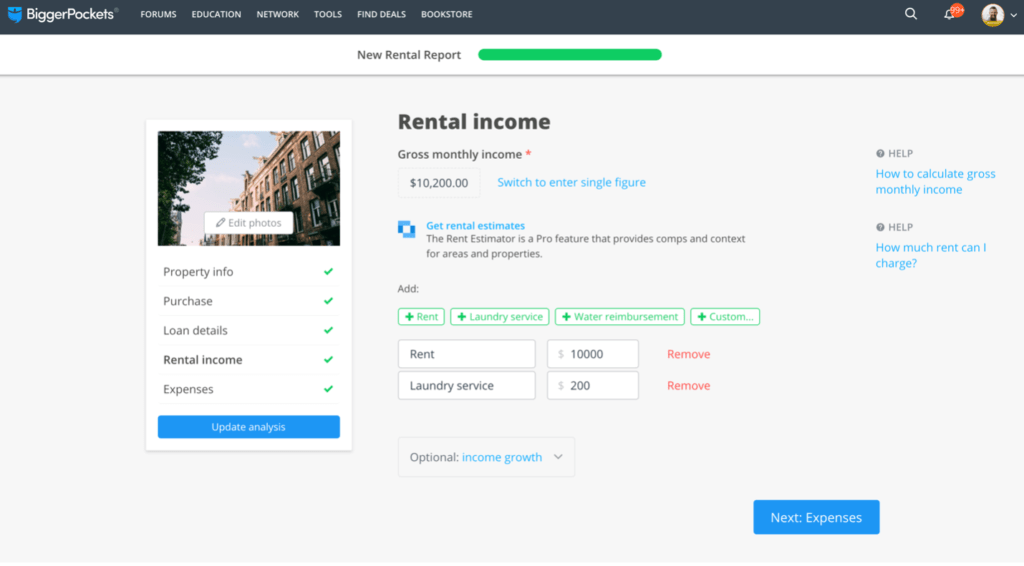
- Average monthly rent: $750
- Other income: $200/month for coin-op laundry
- Utilities: $1,000/month for water, sewer, garbage, and electric
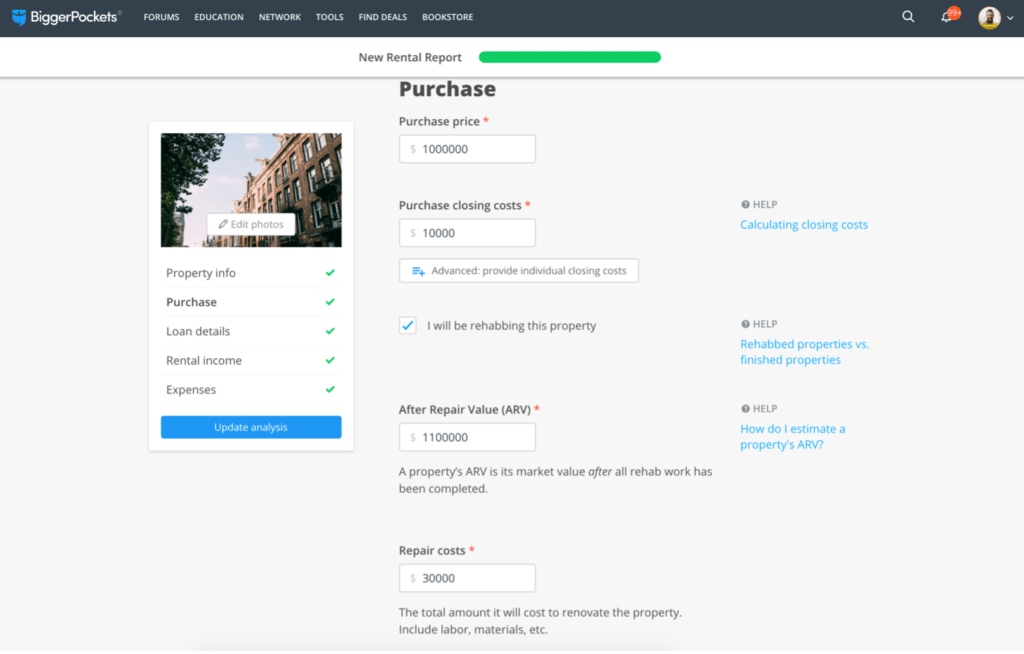
- Condition: Okay, needs nigh $thirty,000 in signage, landscaping, and pigment
- Property taxes: $one,200/month
- Insurance: $2,200/month
- Other expenses: x% of rent for property management and $200 a calendar month for landscaping
- Asking toll: $i,000,000
Mathematical analysis
Side by side, you'll be using the data you collected to determine several key fiscal metrics for the property. While it's possible to exercise this past hand, I'd highly recommend using the BiggerPockets Rental Property Computer, which allows y'all to accurately and efficiently clarify a holding in under 5 minutes. Doing an analysis by mitt or using some random spreadsheet from the net is a skillful way to lose a lot of coin by making small mistakes.
(Note: The BiggerPockets calculators are ideal for properties between one and thirty units. Above 30, y'all'll want a more exhaustive tool like Michael Blank'south Syndicated Deal Analyzer.)
Permit'south become alee and run the numbers on the hypothetical 10-unit multifamily property I outlined above on the BiggerPockets Rental Belongings Calculator.
First, nosotros're going to enter the address and upload a photo:
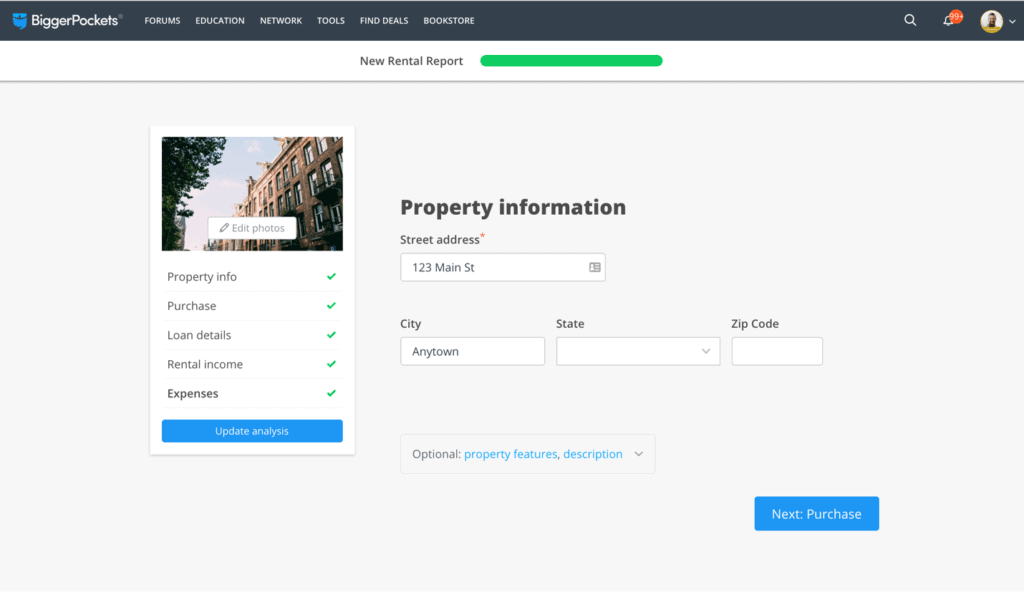
Next, we'll enter the proposed purchase price, endmost costs, after-repair value, and repairs costs. (And hey, if you are using the BiggerPockets calculators and are unsure of how to fill out whatsoever form, just click on the blue help links on the right side.)
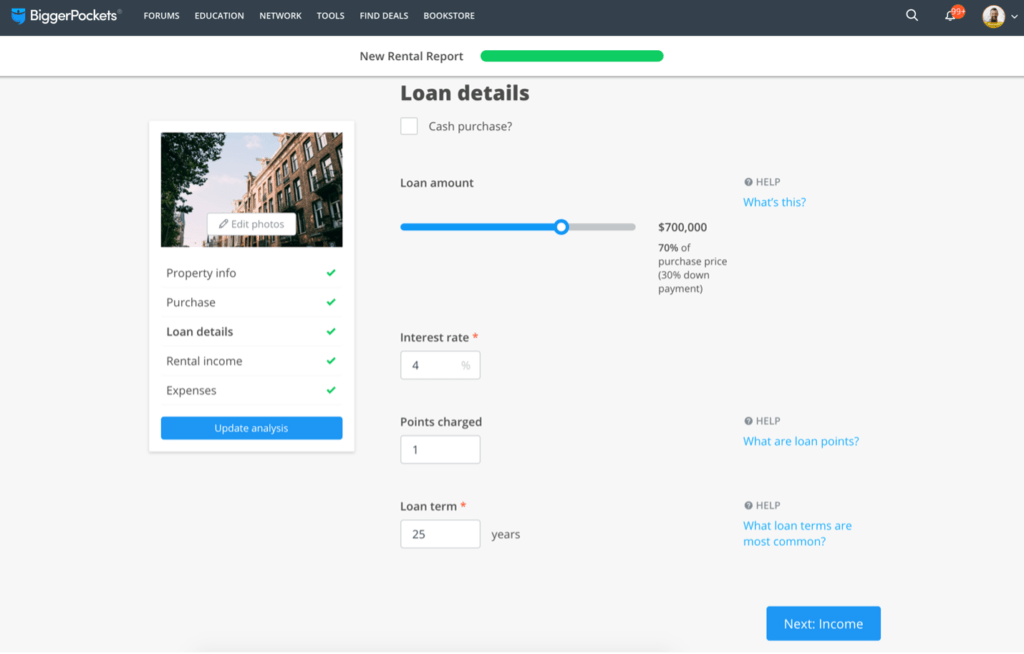
Next, we'll cull our loan amount. In this example, seventy% will mean our downward payment is thirty% of the buy price. We'll also include some details about the loan, which you will exist able to become from your lender.
Now, include the rent and other monthly income.
And finally, include all the expenses for the property. I commonly assume between 5% to 10% for repairs, simply this tin can vary depending on the historic period and condition of the property, as well as other compensating factors.

That'southward information technology for inputs. At present, let'south look at the results.
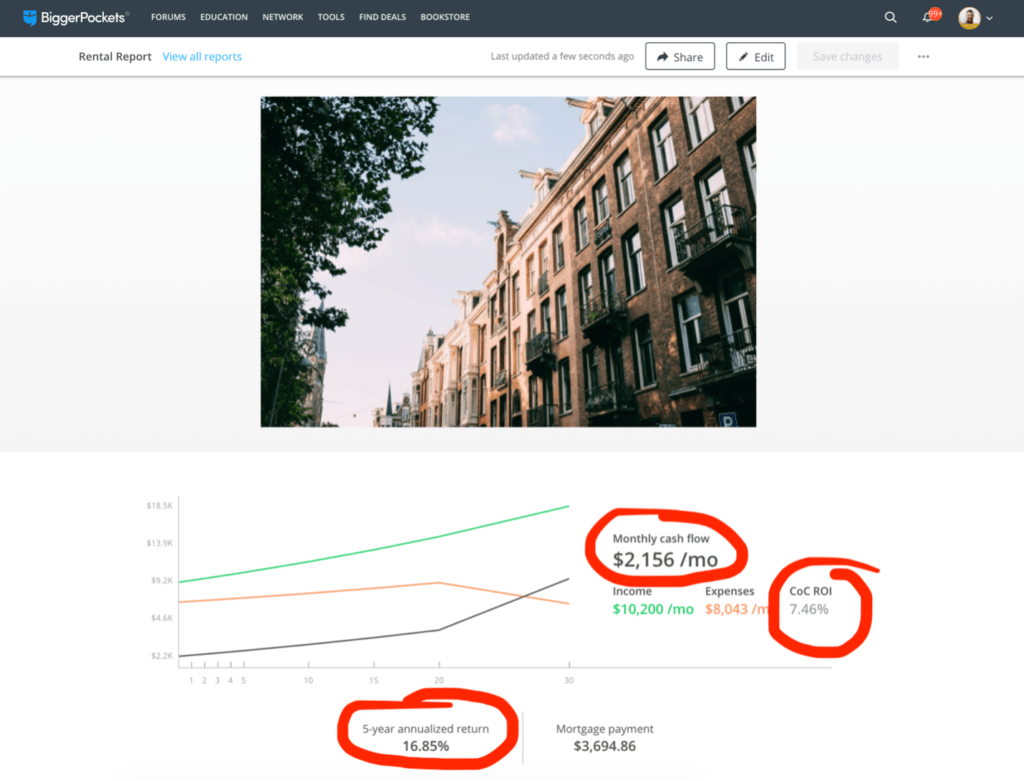
What are we looking at here? Well, when investing in multifamily deals, in that location are several cardinal metrics I look for.
- Greenbacks flow. This is the amount of profit the property produces afterward all of the expenses accept been considered, including the mortgage. Equally a full general dominion of pollex, I like to run into $100 per calendar month, per unit, on a multifamily holding. But this number is not as important as…
- Cash-on-cash render (COC). This is the percentage your investment has fabricated yous in a given yr. To determine this, simply split annual cash catamenia by full capital invested. Every bit a general dominion of thumb, I aim for 8% to 12% COC on a real estate investment, simply this can vary wildly depending on the deal. For example, I might take a smaller COC if I believe the value of the property can become way upwards over time and I'll make more than of my profit when I someday sell.
- Average almanac return. This number gives u.s. a general look at the lifetime success of the holding, knowing that over fourth dimension we volition pay off some of the loan and the belongings will also likely increment in value. Boilerplate almanac return says, "If we account for all of that, what will our investment return be, on average, each year?" As a rule of pollex, I like this number to be at least 14%, and preferably a lot higher, on a five-year agree.
In the case of our example property at 123 Primary Street, we can see that this property is projected to produce more than $200 per calendar month, per unit in cash flow (which is above my metric goal), 7.46% cash-on-cash return (which is merely slightly below my minimum), and a five-year annualized annual render of 16.85%, which is above my goal.
Now, if I want to reach all three of these metrics, I have a option: I can give upwardly and go back to the drawing board, since this property only works for two of the iii, or I can simply lower my buy cost slightly to determine at what price I will achieve my goal.
This is how underwriting works. You find the number that works, and you go after it. Yous go along out the emotion. Yous stick to the math. And you lot pursue the deal based on the metrics you lot've defined every bit important.
Now, let's move onto another attribute of multifamily underwriting, and that'due south determining what a property "should" be worth. How would someone know?
What is a multifamily belongings worth?
At present that is a loaded question.
First, as with all things in a capitalist society, something is worth what someone else is willing to pay for it. But that's a lame answer, so let's become deeper.
What'southward it worth to you?
In other words, what toll tin you pay to make your deal pencil out to a solid investment for yous? For example, if your goal was an 8% greenbacks-on-greenbacks render, the deal above should pencil out higher up that number at a buy cost of $970,000. Merely is it actually worth $970,000?
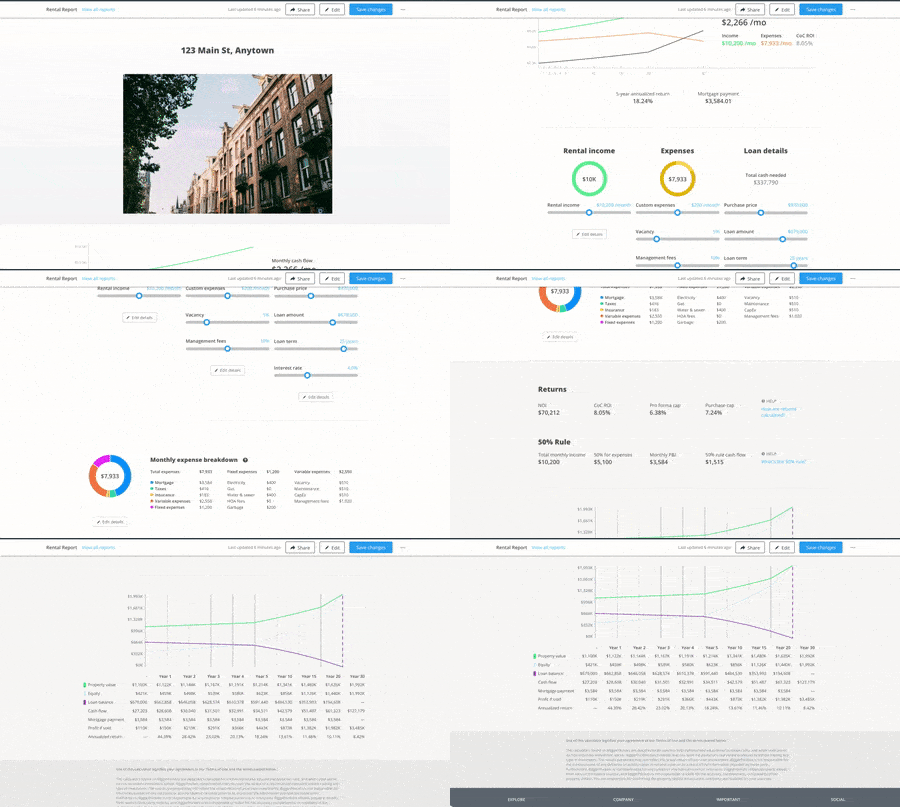
Well, permit's go one step further in terms of valuing a multifamily property and look at how an appraiser would evaluate the property.
First, this is another distinction betoken betwixt small and large multifamily. Smaller, two- to iv-unit of measurement backdrop are generally valued the same fashion single-family houses are: past looking at what similar properties have sold for. An appraiser would look at contempo sales ("comps") and presume that the target holding will be worth around the same amount,
Now, when we're talking about larger multifamily properties (five units or greater), appraisers take a much dissimilar fashion of determining value.
Because information technology's hard to find identical properties to compare one's big multifamily to, appraisers instead look at the profitability of the investment and compare that to other commercial existent manor investments in the area. This concept alone is enough to write a whole affiliate on, but simply stated, the value of a large multifamily property can be determined using the following formula:
Net Operating Income (NOI) / Cap Rate = Value
- Net operating income (NOI) is the profit a holding would make in a year, not including whatever debt payment or capital expenditures (CapEx).
- Cap rate is the expected cash-on-cash render investors typically want to run across in a similar investment, assuming they paid all cash.
So, if a property's NOI is $500,000 per year, and the normal cap rate in an expanse is 5%, so:
$500,000 / .05 = $10,000,000
Now, does that mean you should only pay $10,000,000 for this property? Not necessarily. Maybe the property needs to be improved. Maybe you lot can go it cheaper. Maybe you tin can increment rents right abroad, so overpaying might make sense in the grand picture. Call back, regardless of these cap rate and NOI formulas, the holding is worth what makes it a good deal for you. So, work backward, stick to the math, and buy a great pocket-size multifamily deal.
Financing a multifamily holding
There are enough of loan types that you can go to finance your multifamily property. Here'south a quick list of the most common ones.
- HUD loans and other government-backed mortgages for house hackers who plan to live in a one- to four-unit property for at least i year.
- Conventional mortgages (most common), typically 20% to 30% down. Near banks or lenders tin do these.
- Portfolio loans. Usually small-scale, local community banks that lend their own money, rather than the government's, and therefore can exist more than flexible.
- Hard money loans. Granted past private individuals or firms with college rates/fees than traditional lenders and much shorter terms. Ordinarily only ideal for set up-and-flip projects or for ownership a nasty property, repairing it, and then refinancing it with a more traditional loan.
In addition, there are many creative strategies that can allow you to invest in real estate with significantly less money, fifty-fifty no money. Possibly the nigh common no/low money downward strategy is that of utilizing partnerships, where one partner brings virtually (or all) of the down payment and the other partner handles the rest (such as finding the deal, negotiations, offers, due diligence, closing, and managing) and profits tin can be split nevertheless the two parties cull–frequently 50/l.
This strategy can be utilized on small deals or large deals. In fact, this is how I've been able to abound my portfolio to more than than 2,000 units in the last few years. My existent manor company, Open up Door Capital, buys large apartments and mobile home parks by raising coin from wealthy individuals (known as "limited partners") while we practice the residue. This can create a real win-win for everyone, as the limited partners become completely passive income while I'm able to scale my unit of measurement count into the thousands. This process is known as syndication and is the primary focus of Volume Two of The Multifamily Millionaire.
In improver to partnerships, at that place are many other strategies that could piece of work, such as seller financing, lease options, BRRRR investing, and more.
If you're curious about more than creative strategies, don't miss my showtime full-length book, The Volume on Investing in Existent Estate with No (and Low) Money Downward.
Making an offering
Now that yous've figured out your financing route (usually it's a good idea to practice this before making offers and so that y'all're not wasting anyone'south time), and y'all know exactly how much you can pay for the property to make information technology worth ownership, information technology's time to make an offer and negotiate a bargain.
If you're using a broker, they can depict up all the legal documents and make sure all your i's are dotted and t'due south are crossed. If not, consider using an attorney to help make your offering.
The document you'll use to make your offer is known as a purchase and sale agreement, or simply "the P&S." Even so, when dealing with complex multifamily property transactions, it's customary to beginning submit a document known as a alphabetic character of intent, or LOI. The LOI is a much simpler document—normally just one page—that spells out the of import stuff, such every bit who you are, the amount you are offering, the date you'll shut, and how yous'll finance the deal. The LOI, although not legally binding, allows both parties to negotiate before spending thousands of dollars and weeks of time on the thousands of pocket-size items found in the P&S.
Later on making your offering, y'all may get a aye, a no, or a negotiation.
If competition is intense (which is often the case), you should do whatever y'all can to entice the seller to pick you lot.
Ane manner to do this (beyond price) is to give a shorter closing time. Instead of the standard 30-45 days, offering to have the deal done in two weeks. This may put a lot of force per unit area on you as a buyer, since y'all'll have to run through inspections and more during the due diligence period, just sometimes letting a seller know that their payday is in 2 weeks is enough to brand them bend a lilliputian. Merely note that quick turnarounds on endmost might eliminate financing options like conventional mortgages. Be aware of the risks.
You tin also offer more earnest coin. This is a per centum of the property'southward price given as a deposit to bear witness your seriousness about the purchase. More money tin can indicate more commitment. Typically, earnest coin is between ane% and iii% of the purchase price, and is generally refundable if you back out for reasons outlined in your offer, up to a certain time menstruum besides defined past the offer.
Heir-apparent's due diligence
The due diligence flow is a fix corporeality of fourth dimension before closing where the buyer can pick apart the property with inspections and tests to ensure that they want to brand the purchase. Information technology also gives fourth dimension to finalize financing and ensure everything closes smoothly.
One of the most important things for you lot to practise during this time is getting an inspection. This volition assistance determine whether y'all're making the right investment.
You'll also use this time to dig into the financials of the investment, double- and triple-checking that your estimates for income and expenses are accurate. Insurance tin can be ordered during this time, management can be hired, financing is finalized, and lawyers or the title visitor will handle the legal paperwork and title searches.
Whatever else you determine to practise during this period, make sure that you're getting it done before it ends so that you don't observe something that ruins the deal later, when it's as well belatedly to back out.
When your due diligence period is up, there's only one thing left to do: Close on your new multifamily property!
Managing multifamily
When information technology comes to managing your multifamily, you have several options. With a smaller multifamily, you may choose to manage it yourself. Managing tenants is non an overly complicated process, just there are some vital legal and functional rules and processes yous should follow.
But landlording is not for the faint of heart or weak of will. You volition need to exist professional, house, and systemized. You must learn how to advertise vacant units, screen tenants, sign leases, and handle problems when they arise (and they volition). If you plan to go this route, be sure to read some good books on managing tenants, such as the book I wrote with my wife, The Volume on Managing Rental Properties.
If you cull not to manage the units yourself, you will need to engage a professional person property management company. Typically, these companies charge between five% and 10% of the rent nerveless as their payment, plus other leasing fees. Yet, this tin give you lot a meaning amount of your time dorsum, assuasive you more time to notice other deals (or to lie on a beach). Merely keep in mind that fifty-fifty if you hire a manager, you'll notwithstanding need to spotter over the manager and brand sure they are doing a good task–or y'all'll demand to replace them.
Congratulations! Yous've made information technology to the end. At this indicate, you should have a belongings going from the seller's hands into yours—and producing great monthly cash flow and making you wealthier each and every month.
Source: https://www.biggerpockets.com/guides/buying-multifamily
0 Response to "How to Get Your First Multi Family Property"
Post a Comment